
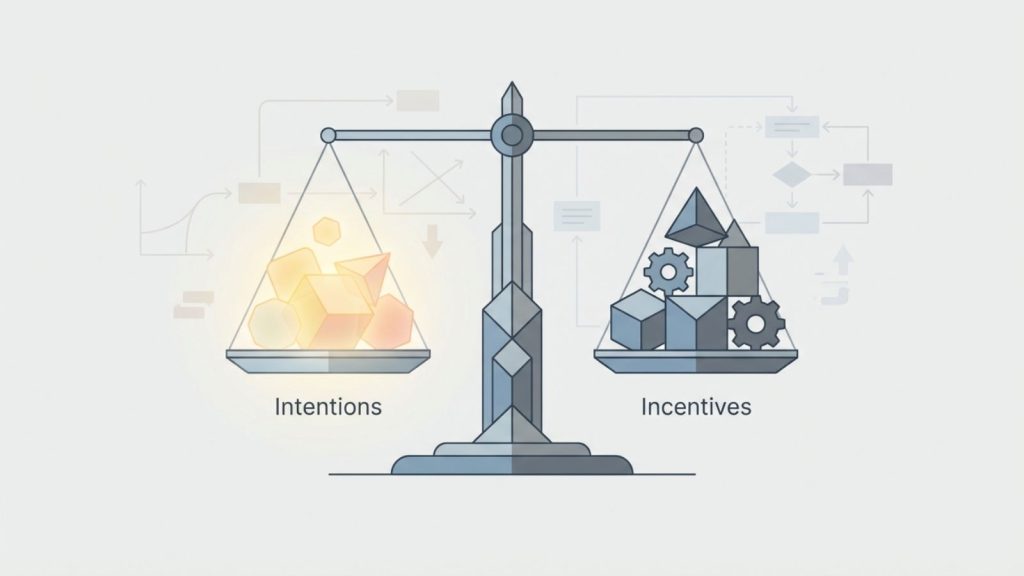
Understanding economic behavior isn’t actually about guessing people’s motives.
Most of us assume intentions drive decisions — that if we just understood what people wanted, we’d understand why they acted the way they did.
But in real-world economics, it’s incentives — not intentions — that reliably shape outcomes.
This post walks you through why incentives quietly overpower even the best intentions, how this plays out across industries and public policy, and how you can start analyzing systems with far more clarity. Think of this as a calm, practical lens for seeing human behavior without ideology or moral drama.
Key Takeaways at a Glance
Short on time? Here’s the core idea: incentives shape economic behavior far more reliably than stated intentions.
- Intentions describe what people hope to do, but incentives determine what they actually do.
- Financial, social, and structural incentives quietly guide behavior, even when no one consciously notices them.
- Most policy failures and organizational contradictions come from misaligned incentives, not bad motives.
- Mapping what a system truly rewards makes outcomes predictable — regardless of what people publicly claim to value.
- Designing better incentives (or removing friction) leads to more consistent behavior than relying on willpower or moral appeals.
The Gap Between What People Mean and What People Do
We often expect good intentions to produce good outcomes.
We expect moral values to translate into consistent behavior.
We expect companies, governments, and individuals to “do the right thing” because they said they wanted to.
In practice, that’s not how most systems work.
Intentions describe what people hope to do.
Incentives describe what makes certain actions easier, safer, more rewarding, or more likely than others.
Why intentions feel intuitively powerful
Intentions are emotionally compelling.
They sound sincere, they reveal identity, and they make us feel like we understand someone’s moral stance. When a politician promises reform or a CEO promises sustainability, it’s natural to believe the intention is what matters.
But intentions don’t remove constraints.
They don’t change trade-offs.
They don’t erase the pressures people face inside systems.
Why incentives quietly override them
Incentives sit underneath everything — shaping behavior whether or not anyone talks about them.
If a system rewards one outcome and punishes another, people eventually follow the reward.
Not because they’re bad people.
Because they’re human.
Incentives work even on people with noble motives. That’s why understanding them gives us a much clearer picture of how economies actually function.
What Economists Actually Mean by “Incentives”
Before we go deeper, we need a clean definition:
Incentives are the built-in forces that guide people toward certain choices and away from others.
They can be financial, social, structural, or even psychological.
And they operate regardless of anyone’s stated intentions.
The three types: financial, social, structural

Most economic incentives fall into one of these categories:
- Financial incentives — money gained, money saved, or money lost
- Social incentives — approval, status, reputation, belonging
- Structural incentives — rules, constraints, systems, frictions, default settings
A teacher may intend to give every student equal attention.
But the system might subtly reward test scores (structural), parents’ evaluations (social), or district funding metrics (financial).
Over time, incentives — not intentions — shape the actual behavior.
Why incentives work even when no one notices them
If you place a small friction in front of an action (extra paperwork, a long form, a confusing process), people naturally avoid it.
If you reduce friction, the behavior increases.
These forces don’t depend on morality, willpower, or intellect.
They’re simply part of how humans interact with their environment.
People respond to incentives even when they don’t consciously recognize them, which is why analyzing them gives you predictive power.
Classic Real-World Patterns: How Incentives Shape Outcomes Everywhere
When you look closely, many economic stories — good and bad — are actually stories about incentives, not intentions.
When well-meaning policies backfire
A policy can have the noblest goals in the world and still fail if it creates the wrong incentives.
Common examples include:
- Price controls that unintentionally reduce supply
- Subsidies that raise demand faster than supply can adjust, increasing prices
- Strict quotas that encourage black markets or corruption
- Generous short-term benefits that discourage long-term participation in the workforce
These aren’t failures of morality.
They’re failures of incentive design.
When companies optimize for metrics instead of mission
Most companies intend to serve customers well.
But the moment a metric becomes the measure of success, behavior shifts toward whatever increases that metric.
- Schools “teach to the test.”
- Hospitals optimize for throughput instead of time per patient.
- Social media platforms—regardless of mission—optimize for engagement.
People inside these systems don’t wake up wanting to distort outcomes.
The incentive structure slowly nudges them there.
When personal incentives conflict with collective goals
The tragedy of the commons is the classic example:
Individually rational actions become collectively harmful.
- Overfishing
- Traffic congestion
- Overusing shared resources
- Pollution in waterways
Everyone may intend to preserve the resource.
But if the structure rewards immediate extraction, the system wins over personal ideals.
Incentives don’t need villains; they only need misalignment.
Want to Explore More Mind Treks?
We’ve built a growing collection of free, structured learning journeys across psychology, decision-making, career growth, money clarity, and more. No funnels. No upsells. Just deep, honest learning.
Browse All TreksThe Psychology Behind Incentives: Why Humans Respond the Way They Do
Economics and psychology converge here: humans naturally drift toward whatever reduces friction and increases reward.
People move toward rewards and away from friction
This simple idea explains a huge share of human behavior:
- We choose apps that make something easier
- We stick with defaults because switching is effort
- We avoid paperwork even for benefits we actually want
- We gravitate toward socially rewarding environments
A tiny friction can override a big intention.
Social incentives: status, identity, belonging
Not all incentives involve money.
People care deeply about:
- Reputation
- Community norms
- Peer approval
- Identity alignment
A policy or product fails not because the economics are wrong, but because the social incentives surrounding it are stronger.
Intention blindness: why we overestimate our own motives
Humans tend to believe:
“If I know what I should do, I will do it.”
Reality is gentler and more complicated.
We consistently underestimate how much context shapes behavior.
This isn’t weakness — it’s simply how humans operate within systems.
Seeing Systems Clearly: How to Analyze Any Situation by Its Incentive Structure
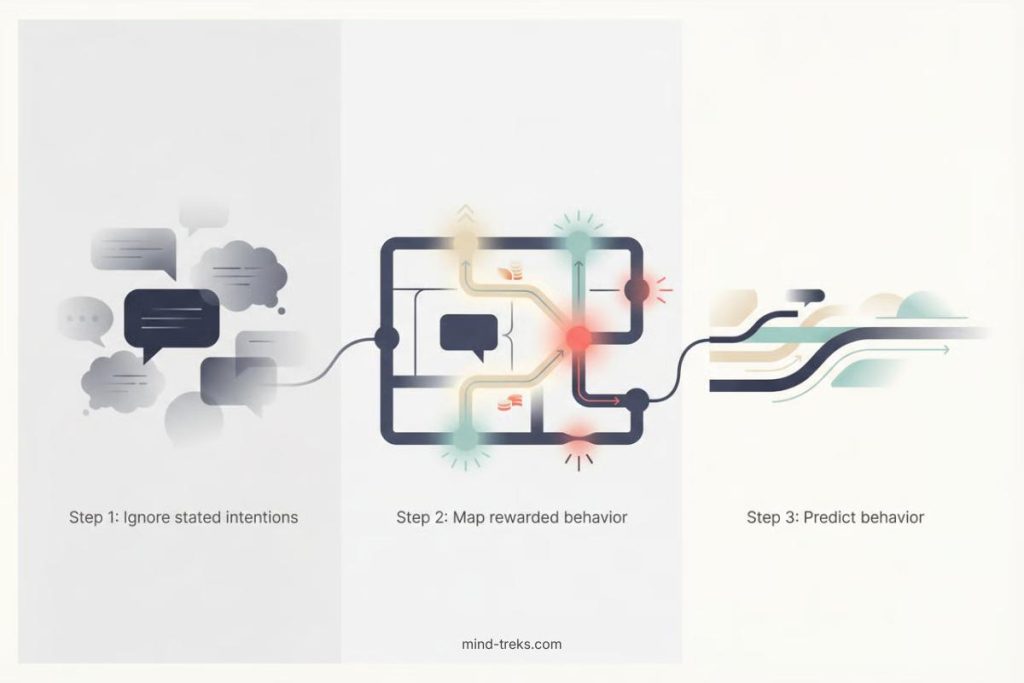
Once you start looking for incentives, systems become far more legible.
You don’t have to guess what people “believe” — you can understand what they are encouraged to do.
Here’s a simple method.
Step 1: Ignore what people say they want
Not dismissively — just temporarily.
Intentions rarely predict behavior until they align with incentives.
Step 2: Map what behavior the system is actually rewarding
Ask simple questions:
- What gets someone praised?
- What gets them paid?
- What gets them fired?
- What gets them approved?
- What gets them noticed?
- What gets them punished or criticized?
This is where the real rules live.
Step 3: Predict behavior based on incentives, not narratives
If a system rewards speed over quality, expect rushed work.
If a system penalizes risk-taking, expect stagnation.
If a system rewards short-term wins, expect short-term thinking.
You don’t need ideology here — only observation.
Why This Matters for Citizens, Leaders, and Everyday Decisions
Understanding incentives isn’t just for economists.
It’s a practical life skill.
For public debates: incentives clarify, ideology distorts
Most big political arguments hide a simpler question:
“What behavior does this policy actually encourage?”
That single question cuts through slogans quickly.
For workplaces: align incentives or watch intentions collapse
Organizations run into predictable trouble when:
- Leaders state values they don’t reward
- Teams are punished for the very things they’re told to prioritize
- Metrics overshadow mission
People cannot sustainably fight their own incentives.
For personal choices: design environments that make the “good path” easier
This is the most empowering part.
You can redesign your own incentives:
- Put healthy food where it’s visible
- Pre-commit to saving automatically
- Remove friction from important habits
- Add friction to distractions
- Simplify your default choices
You don’t need more willpower.
You need better incentive architecture.
Conclusion
Intentions matter — but they’re not the engine of economic behavior.
Incentives are.
When you learn to map incentives, you stop being confused by contradictions or idealistic promises. You begin to understand why people, organizations, and governments behave the way they do — even when it contradicts what they publicly claim to value.
The more clearly you see incentives, the more clearly you see systems.
And once you see systems clearly, you can participate in them — or change them — with far more wisdom and far less frustration.
See the Systems Behind Everyday Behavior
If this article helped you see how incentives quietly shape outcomes, the next step is learning how to read systems with even greater clarity. This free Trek walks you through incentives, information flows, institutions, and the hidden structures that drive economic results—without ideology or jargon.
Explore the Free Trek
Why you can trust this guide
Mind Treks is built by a small team of curious, long-time learners who turn complex systems into calm, honest explanations — with no gurus, no upsells, and no ideological agendas.
This article on incentives and intentions draws from behavioral economics, psychology, and real-world system dynamics to explain why outcomes follow incentives more reliably than stated motives.
- No ideological framing or moralizing — only clear, practical analysis.
- Research-informed explanations written in plain, accessible language.
- A focus on helping you see systems clearly, not telling you what to believe.
Frequently Asked Questions
A few more questions people often ask about incentives, intentions, and why economic outcomes don’t always match what people say they want.
-
Intentions describe what people hope to do, but incentives describe what is rewarded, punished, or made easier in practice. Over time, behavior tends to follow the incentives built into a system, even when people sincerely want something different.
-
Intentions still matter for trust, ethics, and long-term relationships. The point isn’t to dismiss motives, but to recognize that good intentions can’t reliably override a system that rewards opposite behavior. For predicting outcomes, incentives are more reliable than stated motives.
-
Look at what gets people paid, promoted, praised, or punished. Ask who gains, who loses, and what behaviors become easier or harder. Those practical consequences usually reveal the true incentive structure more clearly than any public explanation or slogan.
-
Not necessarily. Misaligned incentives often emerge from well-meaning rules, metrics, or habits that accidentally reward the wrong outcomes. Corruption adds intentional abuse of a system, but many problems can be explained by ordinary people responding rationally to poorly designed incentives.
-
Start by noticing where your current environment makes unhelpful behaviors easy and helpful behaviors difficult. Then adjust small incentives: add friction to distractions, remove friction from good habits, and align rewards and recognition with the outcomes you actually care about.