
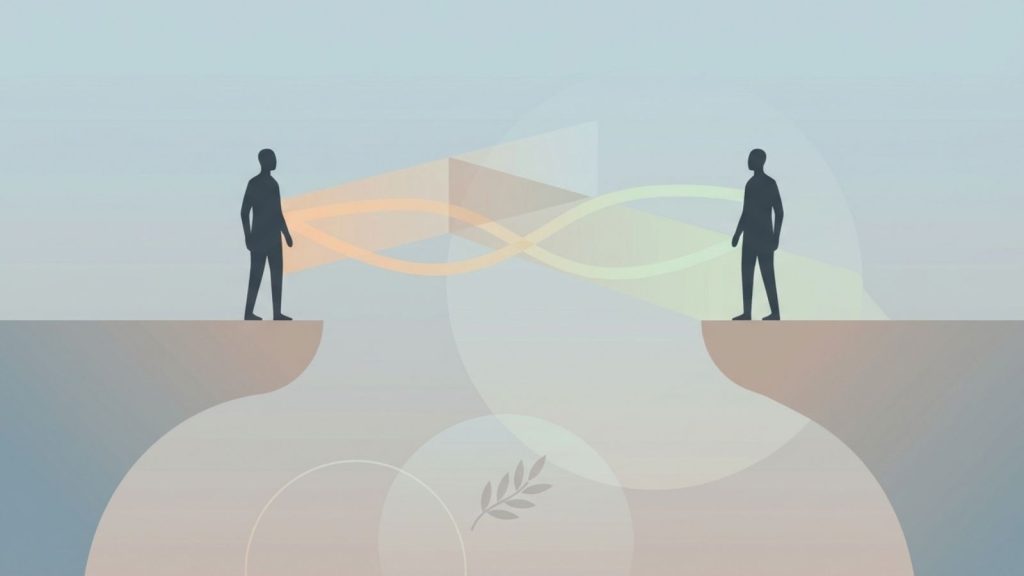
Why do thoughtful, compassionate people look at the same issue and come to completely different conclusions?
It’s one of the most common human questions — especially in a world where moral debates seem louder, sharper, and more personal than ever.
If you’ve ever walked away from a conversation thinking, “How can they not see what I see?”, you’re in the right place.
This guide offers a calm, clear explanation grounded in psychology and everyday experience — not ideology, not tribal talking points.
By the end, you’ll understand why moral conflict exists, why it feels so emotional, and why disagreement doesn’t mean someone is bad, irrational, or uninformed.
You’ll also learn practical ways to have more grounded, less draining conversations across moral differences.
Let’s start with the foundation.
Key Takeaways at a Glance
Short on time? Here’s the core of why good, reasonable people often disagree — and what psychology says is happening underneath.
- Morality isn’t one thing — it’s a stack of influences (intuition, culture, religion, reasoning, and personal experience) that people weigh differently.
- Most moral reactions start as fast, intuitive “gut” judgments; reasoning usually comes afterward to explain them.
- Cultural background and group identity shape what people see as harmful, fair, loyal, safe, or free — often without conscious awareness.
- People prioritize moral values differently (care, fairness, loyalty, authority, freedom), which leads to sincere but conflicting conclusions.
- Moral debates break down not from bad intent, but from mismatched assumptions, language, and underlying values.
Morality Isn’t One Thing — It’s a Stack of Influences
When people disagree about moral issues, the assumption is often:
“Someone here must be wrong — or misinformed — or biased.”
But psychology paints a different picture.
Moral judgment doesn’t come from a single source.
It’s a layered structure — a stack — built from biology, culture, personal experience, and reasoning. Each layer influences the others. And because no two people share the exact same combination, disagreement is the default, not the exception.
Here’s a simple way to visualize it.
The Six Layers of Moral Formation
- Evolutionary Instincts
Basic survival mechanisms shaped how early humans reacted to harm, fairness, safety, and group cohesion. - Cultural Norms
What your community quietly taught you about right and wrong long before you were aware of learning anything at all. - Religious Moral Systems
Ancient stories, commandments, or spiritual teachings that offer structured moral rules. - Secular Reasoning Frameworks
Modern, rational models (like human rights, utilitarianism, or justice theories) that shape how people think about ethics today. - Personal Experience
The unique moments that left a mark — what you lived through, witnessed, or endured. - Individual Reflection & Integration
The meaning-making layer: how you integrate all the above into your own sense of right and wrong.
Every person has these layers — but the order of importance and the level of influence differ dramatically.
That’s the root of moral diversity.
Moral Intuitions Come First, Explanations Come Later
One of the most surprising — and humbling — findings in moral psychology is this:
People usually feel their moral judgments before they think them.
The reasoning comes afterward, like a lawyer explaining a decision the judge already made.
This doesn’t mean people are irrational. It simply means that morality is deeply tied to fast, automatic emotional systems.
Why We “Feel” Right Before We Can Explain Why
If you’ve ever had a gut reaction like:
- “That’s unfair.”
- “That seems wrong.”
- “Something about this feels off.”
…that’s moral intuition at work.
It’s quick, efficient, and largely subconscious.
Different people have different intuitive triggers — shaped by the six-layer stack above — which means two sincere individuals can have different instinctive reactions to the same situation.
How This Creates Honest Disagreement
Because intuitions come first:
- We assume our own immediate reaction is universal.
- We expect others to have the same instinct.
- When they don’t, it feels personal — even threatening.
But in reality, they’re simply starting from a different internal signal.
Understanding this softens the conversation.
It replaces “What’s wrong with them?” with “We’re standing on different foundations.”
Cultural and Identity Filters Shape What We See as ‘Good’ or ‘Harmful’
Beyond intuition, there’s another major driver of moral conflict: the cultural lenses we grow up with.
These lenses determine what we even notice, care about, or interpret as a threat or value.
What Our Upbringing Quietly Teaches Us About Right and Wrong
You didn’t only learn morality through explicit lessons like:
- “Share your toys.”
- “Don’t lie.”
- “Be kind.”
You also absorbed thousands of unspoken messages:
- How your family resolved conflict
- What your community praised or criticized
- What your parents feared
- How people around you treated outsiders
- Which topics were safe — or taboo
These embedded norms feel like “common sense” when really, they’re the specific cultural settings of your environment.
Someone raised with a different set of norms isn’t confused — they’re calibrated differently.
Why Identity Groups Anchor Moral Loyalty
People also inherit moral expectations from the groups they belong to:
- Political tribes
- Religious communities
- Professional cultures
- Social movements
- Online subcultures
- National identity
Group membership shapes what feels morally important.
It also teaches subtle expectations: “People like us believe X; people like them believe Y.”
This doesn’t make people sheep.
It makes them human.
We’re social beings who care about belonging — and moral alignment is often a silent condition of membership.
The Five Most Common Moral Priorities (and Why People Rank Them Differently)
Most moral disagreements boil down to something simple:
People care about different moral values — or they rank the same values differently.
Across cultures, five recurring moral priorities show up again and again:
- Care / Harm
Protecting others, reducing suffering. - Fairness / Justice
Ensuring people are treated equally — or appropriately. - Loyalty / Group Cohesion
Valuing the stability and strength of the group. - Authority / Order
Respecting structures that maintain predictability and safety. - Freedom vs. Constraint
Prioritizing personal autonomy over imposed rules.
Everyone cares about all five — but not evenly.
That uneven ranking creates predictable patterns of disagreement.
For example:
- Someone who prioritizes care/harm may focus on minimizing suffering.
- Someone who prioritizes fairness might focus on consistent rules.
- Someone who prioritizes authority/order could focus on stability or safety.
- Someone who prioritizes freedom may resist regulation entirely.
No value is inherently superior.
But the friction between conflicting priorities can make debates feel existential, not analytical.
Different rankings → different conclusions → different moral worlds.
Want to Explore More Mind Treks?
We’ve built a growing collection of free, structured learning journeys across psychology, decision-making, career growth, money clarity, and more. No funnels. No upsells. Just deep, honest learning.
Browse All TreksWhy Talking Past Each Other Is the Default, Not the Exception
Even when two people share the same facts, moral conflict often remains.
Not because they’re stubborn — but because they’re operating from different internal maps.
Here’s why conversations break down so easily.
The False-Consensus Problem
Humans typically assume:
“Other reasonable people probably think like I do.”
This is comforting — until you encounter someone who doesn’t.
Then the disagreement feels shocking or personal.
The Language Mismatch Problem
Even shared words — “fair,” “safe,” “responsible,” “harmful” — carry different meanings across moral frameworks.
You may think you’re agreeing on terms, but you’re talking about different realities.
Why Evidence Rarely Resolves Moral Disputes
Most people do consider evidence seriously — but they interpret it through their moral lens.
- What counts as “harm”?
- What counts as “fair”?
- Who deserves priority?
- What risks matter most?
A study, statistic, or case example doesn’t land the same way for everyone.
This is why moral debates often feel circular:
each person isn’t ignoring the evidence — they’re interpreting it through different values.
How to Disagree Better: Psychology-Based Tools for More Honest Conversations
If moral disagreements are natural — even expected — then the goal isn’t eliminating them.
It’s learning to navigate them with more clarity and less emotional friction.
Here are grounded, research-informed approaches that help conversations stay human, not hostile.
Move from Winning to Understanding
Most arguments collapse because the goal shifts — often unconsciously — from “Let’s understand each other” to “Let me fix your view.”
Understanding doesn’t mean agreeing.
It means slowing down enough to see:
- what value someone is protecting,
- what fear might be sitting beneath their stance,
- and why their conclusion feels right to them.
This mindset shift doesn’t just make the conversation smoother.
It also reduces defensiveness in both directions.
Ask About Values First, Opinions Second
A surprisingly simple question can unlock an entire conversation:
“What value is most important to you in this issue?”
Most people never get asked this.
Yet moral conflict is usually a conflict of priorities, not logic.
Try it, and you’ll notice:
- The room becomes less tense.
- People explain themselves more openly.
- You uncover the root concern faster than debating abstract positions.
Spot the Layer You’re Actually Arguing From
Many arguments aren’t about what they appear to be.
A disagreement labeled as:
- “political,”
- “economic,”
- or “cultural,”
…may actually be happening at a deeper layer:
- intuition,
- fairness framing,
- personal experience,
- or identity loyalty.
If you can spot the layer beneath the surface, the conflict becomes less foggy.
For example:
- A debate about policy might actually be a debate about freedom vs. safety.
- A debate about fairness might actually be about equal treatment vs. proportional treatment.
- A debate about harm may be rooted in who is considered vulnerable.
Seeing the real disagreement reduces the emotional weight.
It moves the conversation from “Why don’t you understand?” to “Oh — we’re starting from different priorities.”
Allow for Partial Overlap Instead of Total Agreement
Moral conversations break down when people feel pressured to adopt a full worldview instead of acknowledging areas of overlap.
Most people agree on the broad strokes:
- harm should be reduced,
- fairness matters,
- communities should be stable,
- freedom is important,
- responsibilities exist.
They simply rank these differently.
Instead of demanding total agreement, aim for:
- areas of overlap
- shared values
- limited agreements
- mutual understanding, even if conclusions diverge
This is not moral relativism.
It’s moral realism — an acknowledgment that people build their frameworks differently.
Conclusion — Moral Conflict Isn’t a Failure of Humanity. It’s a Feature of It.
When good people disagree, it’s tempting to assume bad motives: ignorance, stubbornness, selfishness, or ideological blindness.
But psychology suggests something more honest and far more hopeful:
Most moral disagreements come from different internal architectures, not different levels of goodness.
Once you see morality as a layered system — influenced by intuition, culture, experience, and values — disagreement stops feeling like a personal threat.
It becomes:
- a puzzle to understand,
- a conversation to explore,
- a moment to practice humility,
- and a chance to see the world from a slightly wider angle.
If this topic resonates with you, consider exploring the idea more deeply.
It’s a core theme of the Right, Wrong, and Human Trek — a calm, structured journey into where morality comes from and how to navigate it without dogma or despair.
Go Deeper Into Understanding Morality
If this article helped you see why good people can disagree, the next step is exploring the full architecture of morality itself. This free Trek walks you through where moral values come from, why intuitions differ, and how to build a grounded moral framework without dogma or relativism.
Start the Free Trek
Why you can trust this guide
Mind Treks turns deep, often polarizing topics into clear, grounded explanations — with no agendas, no funnels, and no moral grandstanding.
This article on why good people disagree draws from moral psychology, cultural anthropology, and lived experience observing how values, intuitions, and identities shape real-world conflict.
- No ideology, no tribal takes — just calm, evidence-informed explanation.
- Plain language that respects your intelligence and avoids moralizing.
- A focus on helping you understand why disagreement happens, not telling you which side is right.
Frequently Asked Questions
A few more common questions people ask about moral disagreements, why they feel so personal, and what psychology says is happening beneath the surface.
-
Because morality isn’t one thing — it’s a layered mix of intuition, culture, reasoning, and personal experience. People simply weigh these layers differently, which leads to sincere but conflicting conclusions.
-
Moral judgments are often intuitive before they are logical. When someone challenges your conclusion, it can feel like they’re challenging your identity, values, or group belonging — not just your opinion.
-
Facts don’t land on neutral ground — they land on existing value systems. Two people can interpret the same evidence differently based on which moral priorities they emphasize, such as fairness, harm, freedom, or loyalty.
-
Some disagreements can be eased when people understand the values underneath each other’s views. But many moral differences aren’t about information — they’re about priorities — which means coexistence and clarity often matter more than total agreement.
-
Ask about values rather than positions. Most people respond better when you explore what they’re protecting — fairness, freedom, safety, loyalty — instead of debating the surface-level conclusion. This shifts the conversation from winning to understanding.