

Introduction
Most of us make dozens of decisions every day — what to prioritize at work, how to handle a difficult conversation, whether to spend or save, or simply how to interpret something someone said.
And even though these choices look small, they shape the direction of our lives more than the rare “big” decisions ever will.
The problem?
Modern life is noisy. Everyone has an opinion. Everyone claims to have the “right” system for thinking clearly. If you’re not careful, you can end up stuffing your brain with more frameworks than clarity.
Mental models offer a quieter, more grounded approach. Not magic. Not guru-level theory. Just simple tools that help you see a situation more clearly, cut through noise, and avoid avoidable mistakes.
In this post, we’ll explore a handful of the most useful mental models for normal people — the kind you can actually use in everyday life, not just in philosophy textbooks. The goal is simple: help you make better decisions with less stress, and feel more confident when the path ahead feels foggy.
Key Takeaways at a Glance
Short on time? Here’s the core of what this guide on using mental models for everyday decisions is really saying.
- Mental models are simple thinking tools—not hacks—that help you see situations more clearly and reduce overwhelm.
- You only need a small toolkit of core models like First Principles, Inversion, and the 80/20 Rule to improve daily decisions.
- The value of a model comes from using the right one lightly—not forcing it or treating it like a universal truth.
- Applying a model creates structure, exposes assumptions, and prevents emotional snap-judgments from guiding your choices.
- Start small: apply one model per week and notice where it brings clarity without overcomplicating your life.
What Mental Models Really Are (In Plain Language)
Mental models are thinking tools — short, simple ways of understanding how something works. They give you a clearer map of a situation so you’re not relying only on instinct or reacting emotionally in the moment.
They’re not “hacks” or shortcuts to genius. They’re more like lenses. If you look at a problem through the right lens, things that were blurry suddenly make sense.
A good mental model does three things:
- It simplifies a complex situation without oversimplifying it.
- It exposes assumptions you didn’t realize were shaping your choices.
- It gives you a better structure for deciding what to do next.
Where they fall apart is when people treat them like universal laws. A model is not the truth. It’s a tool — helpful in some moments, irrelevant in others. The value comes from using the right one at the right time, then putting it back in the toolbox.
Why Mental Models Matter in Everyday Life
You don’t need mental models to be a philosopher.
You need them because daily life is full of uncertainty, scattered information, and choices that feel heavier than they should.
The moment your brain feels overloaded, a simple model can help you slow down, zoom out, and see the situation for what it actually is.
Better Decisions With Less Stress
Most decisions feel stressful not because they’re complicated, but because they’re vague.
Mental models give shape to that vagueness.
Instead of asking, “What should I do?” you ask a clearer question like:
- What are the fundamentals here?
- What assumptions am I making?
- What’s the simplest explanation?
This clarity reduces the emotional fog that makes decisions harder than they need to be.
Spotting Hidden Biases Before They Derail You
We all have mental shortcuts and blind spots — it’s part of being human.
Confirmation bias, recency bias, the tendency to overreact to rare events… these can quietly influence your decisions without you realizing it.
Mental models act like a small pause button.
They help you catch yourself before you jump to an assumption that isn’t actually grounded in reality.
Making Choices You Won’t Regret Later
When you use a model, you’re not making a decision from a momentary emotion.
You’re using a structure — something steadier than impulse — which naturally leads to choices that hold up better over time.
Think of it as giving yourself a second opinion, but one you carry in your own mind.
The 7 Most Useful Mental Models for Everyday People
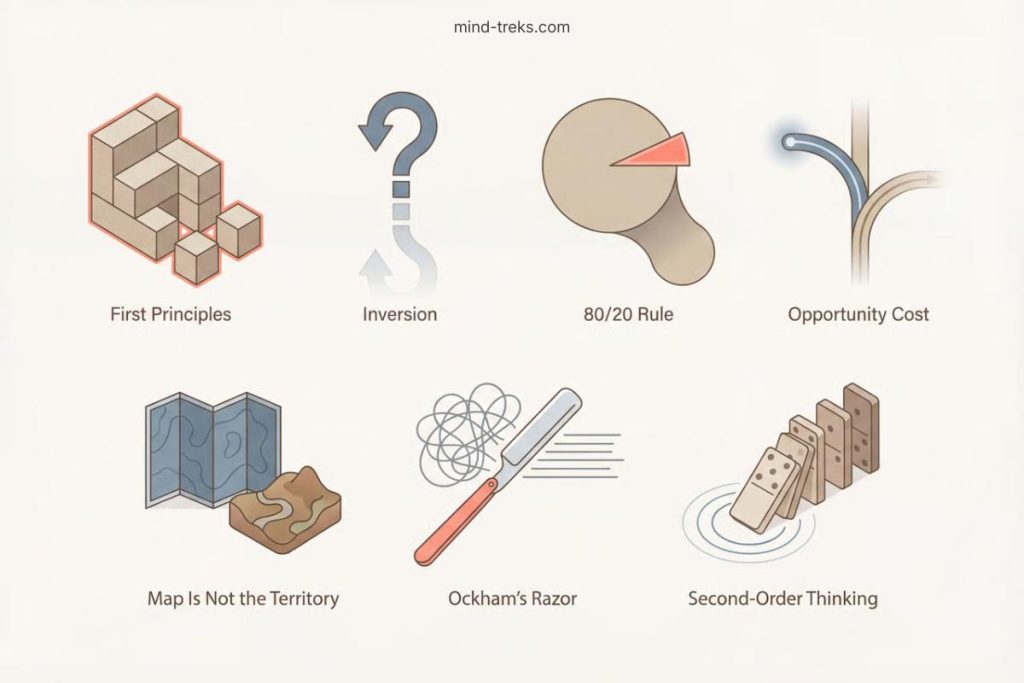
Below are the models you can use immediately — in normal, non-academic, everyday situations. Each one answers a simple question: “How can I see this more clearly?”
1. First Principles Thinking — Simplify Big Questions
First principles thinking helps you strip a problem down to its basic components instead of relying on assumptions or “the way it’s usually done.”
Ask yourself:
- What do I know is true here?
- What am I assuming without realizing it?
- What would this look like if I rebuilt it from scratch?
Everyday example:
You’re considering switching careers. Instead of thinking “I need a degree” or “I’m too late,” you break the question into its fundamentals:
- What skills does this field require?
- Which of those skills can I learn myself?
- What’s the simplest path to start experimenting?
It turns a vague mountain into clear steps.
2. Inversion — Solve Problems by Asking the Opposite
Instead of “How do I succeed?” inversion asks:
“How would I fail?”
This model is especially useful when you’re stuck, overwhelmed, or overthinking.
Examples:
- How would I guarantee I stay unhealthy? (Skip sleep, overeat, stay sedentary.)
- How would I ruin a relationship? (Avoid communication, assume the worst, stop listening.)
Once you identify the failure patterns, avoiding them becomes powerful.
3. The 80/20 Rule — Focus Where It Actually Matters
The 80/20 Rule (Pareto Principle) states that 20% of actions drive 80% of results.
In daily life:
- 20% of your tasks create most of your progress.
- 20% of your habits shape most of your well-being.
- 20% of your decisions influence most of your stress.
Ask:
- “What truly moves the needle?”
- “What could I stop doing without losing much?”
This is a model that naturally reduces overwhelm and restores focus.
4. Opportunity Cost — The Invisible Price of Every Yes
Every choice costs something — money, time, energy, attention, or another possibility.
Opportunity cost doesn’t tell you what to choose; it simply reveals the trade-off you were blind to.
Examples:
- Saying yes to a project means saying no to rest or another priority.
- Spending on something small may delay saving for something meaningful.
You gain clarity by asking:
“What am I giving up by choosing this?”
5. The Map Is Not the Territory — Reality vs. Assumptions
Your internal map — your beliefs, expectations, and assumptions — is not reality itself.
This model helps you stay humble and avoid rigid thinking.
Examples:
- You assume someone ignored your message intentionally — that’s your map, not the territory.
- You think a career path works a certain way — but the real world may differ.
The model invites you to check your assumptions instead of trusting them blindly.
6. Ockham’s Razor — Find the Simplest Explanation That Fits
Ockham’s Razor is a reminder that the simplest explanation is often the best place to start — as long as it still fits the facts.
This model helps when your mind is spinning stories, overanalyzing someone’s intentions, or assuming hidden complexity where there may be none.
Ask yourself:
- What’s the simplest explanation that could reasonably be true?
- Am I adding assumptions to make this feel more dramatic or meaningful?
- If I removed the story, what’s left as the plain reality?
Everyday example:
You send a message and don’t get a reply. Your brain starts building a narrative: “They’re upset,” “I said something wrong,” “They’re ignoring me.” Ockham’s Razor offers a calmer first step: they may simply be busy, distracted, or haven’t seen it yet.
This model doesn’t tell you to ignore real problems.
It helps you avoid creating them when the evidence isn’t there.
7. Second-Order Thinking — Look Past the First Result
Second-order thinking means asking what happens after the immediate outcome.
Not just “Will this work?” but “What does this lead to?”
Most bad decisions feel good in the short term.
Most good decisions feel inconvenient at first.
Ask yourself:
- What’s the likely short-term outcome of this choice?
- What’s the likely longer-term outcome if I repeat this choice?
- What habits, expectations, or consequences am I reinforcing?
Everyday example:
You’re tired and you skip a hard conversation to “keep the peace.” The first-order result is relief. But the second-order result might be resentment, distance, or the issue returning bigger later. Or you choose to have the uncomfortable talk now — and the second-order result is trust and a cleaner relationship over time.
This model is especially useful for money, health, and relationships — the areas where small choices compound quietly, and regret usually arrives late.
How to Use Mental Models Without Overcomplicating Your Life
Mental models are supposed to make life simpler, not turn you into someone carrying a toolbox everywhere you go. The goal isn’t to memorize dozens of frameworks — it’s to have a few reliable ones that help you think more clearly when it matters.
Here’s how to use them without slipping into over-analysis.
Start With One Model Per Week
Most people try to apply too many models at once.
That usually leads to more confusion, not less.
A better approach is to pick one model — First Principles, 80/20, Inversion, whatever feels most helpful — and practice noticing where it naturally applies in your day.
You’re training awareness, not building a library.
Focus on:
- Recognizing when the model fits
- Using it quickly and casually
- Reflecting on whether it clarified the situation
One model, used well, is more powerful than 20 models used poorly.
Build a Small “Decision Toolkit” Instead of Memorizing Lists
Think of your mental models like a pocket toolkit: small, dependable, familiar.
You don’t need 40+ models.
You need 4–7 that consistently help you think more clearly.
A good toolkit might include:
- First Principles
- Inversion
- 80/20 Rule
- Opportunity Cost
- Ockham’s Razor
- The Map Is Not the Territory
That’s enough to navigate most of life.
A small set keeps you grounded and prevents the temptation to over-intellectualize simple moments.
Notice When a Problem Doesn’t Need a Model at All
Sometimes you just need to make the call, send the message, rest, or move forward.
Mental models are helpful in moments of fog, complexity, or emotional intensity.
They’re not meant to replace everyday intuition.
A useful check-in:
- Is this choice actually complicated?
- Am I using a model to avoid discomfort?
- Is the simplest answer already obvious?
If the answer is “yes,” trust yourself and move on.
Want to Explore More Mind Treks?
We’ve built a growing collection of free, structured learning journeys across psychology, decision-making, career growth, money clarity, and more. No funnels. No upsells. Just deep, honest learning.
Browse All TreksApplying Mental Models to Common Everyday Decisions
Mental models aren’t just for learning, debating, or building businesses.
They’re most powerful when used in the everyday choices that quietly shape your life.
Here’s what that looks like across different areas.
Personal Finances
Finance is full of noise, emotion, and conflicting advice.
Models help you stay grounded.
Examples:
- Opportunity Cost: “If I buy this, what gets delayed?”
- 80/20 Rule: “Which spending categories are actually impacting my savings?”
- Inversion: “What would guarantee I stay stressed about money?”
These give you clarity without requiring complicated spreadsheets.
Work & Career
Work is where many people feel stuck — not because they lack skill, but because they lack clarity.
Mental models help by reframing the problem:
- First Principles: “What does this job actually require for success?”
- Ockham’s Razor: “What’s the simplest explanation behind this conflict or feedback?”
- 80/20: “What 20% of my tasks create most of my value here?”
You begin to see your work less emotionally and more structurally — which makes better choices easier.
Personal Life & Relationships
This is where the models show their human usefulness.
Examples:
- The Map Is Not the Territory: Don’t jump to conclusions about someone’s tone or intentions.
- Inversion: Want healthier relationships? Start by avoiding the things that reliably harm them.
- Opportunity Cost: Time spent on one relationship dynamic is time not spent on another.
Models don’t remove emotion — they help you interpret situations with more clarity and less projection.
When Mental Models Fail — And What to Do Instead
Mental models are helpful, but they’re not a replacement for real-world data, emotional intelligence, or lived experience.
They have limits.
Overconfidence and False Certainty
Sometimes a model gives you a sense of clarity that isn’t deserved.
You may think you understand a situation because the model fits — but you’re still missing important details.
The fix:
Stay open to new information. Use the model as a hypothesis, not a conclusion.
Using Too Many Models at Once
This is analysis paralysis disguised as intelligence.
If you find yourself asking:
- “Should I use First Principles or Inversion?”
- “Is this 80/20 or Ockham’s Razor?”
…stop.
Models are optional shortcuts, not required steps.
Pick the one that feels simplest and apply it lightly.
Confusing a Model for Universal Truth
Every model simplifies reality.
None of them describe it perfectly.
A model should help you think — not dictate how you think.
If you treat it as law, you’ll misapply it.
When You Need Real-World Input Instead
Some decisions require data, experience, or feedback from someone who’s been there.
A model can help you frame the question, but it can’t replace:
- trying something small
- getting feedback
- observing results
- adjusting
Think of models as the starting point, not the finish line.
Conclusion
Mental models are simple thinking tools that help you navigate a noisy world with more clarity and less stress. They won’t turn you into a genius or remove uncertainty, but they will help you see situations more honestly — and avoid avoidable mistakes.
You don’t need to memorize dozens of frameworks.
You just need a small toolkit and the habit of pausing before reacting.
If you want to go deeper, the next step is learning how to make decisions when the path really is foggy — when information is unclear, emotions are loud, and there’s no obvious answer. That’s exactly what our Decision-Making When the Path Is Foggy Trek is built for: practical clarity when it matters most.
Go Deeper Into Better Decision-Making
If these mental models helped you see everyday choices more clearly, the next step is learning how to stay steady when the path ahead feels uncertain. Our free Trek walks you through making grounded, confident decisions even when information is incomplete, emotions are loud, or the stakes feel high.
Start the Free Trek
Why you can trust this guide
Mind Treks is built by lifelong learners who turn complex ideas into calm, structured explanations — entirely free, with no gimmicks or guru-style promises.
This article on mental models draws from psychology, behavioral science, and years of real-world decision-making — from careers and money to relationships and everyday clarity. Our goal is simple: turn useful thinking tools into something normal people can actually apply.
- No hype, shortcuts, or “secret frameworks.”
- Plain language grounded in research and lived experience.
- A focus on helping you think better, not telling you what to think.
Frequently Asked Questions
A few more questions people often ask about mental models, clear thinking, and making better everyday decisions.
-
Start by picking one model—like First Principles or the 80/20 Rule—and apply it to small, low-stakes decisions for a week. You’re not trying to be perfect; you’re just training yourself to pause, use the lens, and notice whether it brings a bit more clarity.
-
If a situation feels complicated, First Principles or the 80/20 Rule are good defaults. If you feel stuck, try Inversion; if you notice you’re making assumptions, use “The map is not the territory.” Choose the model that feels simplest and most natural for the kind of decision you’re facing.
-
They can if you treat them as absolute truths instead of tools. A model is just one way of looking at reality, so if you force it onto every situation or ignore new information, it can narrow your perspective instead of sharpening it.
-
In emotional situations, a model can be helpful as a first step to slow down your reaction and name what’s going on. After that, you still need real conversations, feedback, and time—models support your judgment, they don’t replace the human part of the decision.
-
Most people only need a core set of four to seven models they know well and actually use. A smaller toolkit keeps things practical and prevents the kind of overthinking that happens when you try to run every decision through a long list of frameworks.