

Long-term investing has a strange reputation online.
People talk about it like it’s a mystical skill — something only insiders, experts, or people with perfect timing can do.
But the truth is simpler.
Long-term investing is less about predicting the future and more about building clarity, reducing noise, and making decisions you can stick with for years. This guide is written specifically for long-term investing for beginners — people who want a steady, grounded way to grow wealth without guessing the market or chasing headlines.
If you’ve ever felt overwhelmed by market headlines, unsure where to begin, or frustrated by conflicting advice, this guide is built for you.
You’ll learn what long-term investing actually means, how to start without guessing the market, and how to stay grounded when everything feels uncertain.
No hype.
No “secret strategies.”
Just a clear path forward — the kind most people never get to see.
Key Takeaways at a Glance
Short on time? Here’s the heart of this calm beginner’s guide to long-term investing without chasing predictions.
- Long-term investing isn’t about predicting the next move — it’s about building a simple plan you can stick with for years.
- Your time horizon and risk comfort level matter more than finding the “perfect” stock or timing the market.
- Broad, diversified investments (like index funds) reduce pressure to guess winners and let the whole market work for you.
- Automating regular contributions turns investing into a habit and helps you stay consistent through ups and downs.
- When markets swing, reconnecting with your plan — not the headlines — is what keeps you grounded and on track.
Why Most Beginners Feel Overwhelmed by Investing
Most people don’t struggle with investing because they’re “bad with money.”
They struggle because the environment around investing is built to create noise.
The Modern Noise Problem
If you scroll for even a minute, you’ll see:
- People predicting the next crash
- People predicting the next boom
- Charts with arrows pointing in every possible direction
- Influencers calling every stock “the next big thing”
It’s confusing not because you’re uninformed — but because nobody can agree, and many of them aren’t trying to help you. They’re trying to keep you watching.
The Real Question Beginners Should Ask
Instead of:
“What should I buy right now?”
A better question — calmer, clearer — is:
“How can I invest steadily without feeling lost or anxious?”
That question leads you to long-term investing, not prediction-chasing.
What Is Long-Term Investing? (Plain-Language Explanation)
Long-term investing for beginners means putting money into diversified assets, contributing consistently over time, and letting compounding work over years or decades — instead of trying to predict short-term market moves.
So basically, placing your money into assets you expect will grow over years — not days or weeks — and letting time do most of the heavy lifting.
The Difference Between Trading, Speculating, and Investing
Trading is about speed. Days or minutes.
Speculating is about guessing. Often confidently, rarely accurately.
Investing is about patience and clarity.
Investing asks a different set of questions:
- What has historically grown over long periods?
- What’s simple enough that I can stick with it?
- How do I avoid blowing myself up emotionally along the way?
You’re not trying to outsmart the market — you’re trying to participate in it responsibly.
Why Time — Not Timing — Drives Most Returns
This is one of the most counterintuitive lessons for beginners:
You don’t need perfect timing. You need time.
When you invest steadily over many years, you gain the benefit of:
- Compounding (growth that builds on growth)
- Riding out short-term dips
- Exposure to entire market cycles
The simple structure of “add money consistently + wait” outperforms most prediction-chasers over decades.
What Long-Term Investors Ignore on Purpose
To stay sane, long-term investors intentionally tune out:
- Micro headlines
- Crash predictions
- Viral stock picks
- Fear-of-missing-out hype
- Overconfident experts
This isn’t ignorance.
It’s discipline — one rooted in understanding how markets actually behave over time.
What Foundations Do Beginners Need Before Investing Long Term?
Before you invest a single dollar, build the foundation that will support everything else.
This is the part most blogs skip, but it’s what actually prevents anxiety later.
Step 1 — Define Your Real Time Horizon
Your time horizon is simply:
“When will I realistically need this money?”
Not the idealistic answer — the honest one.
Short-term money (0–3 years) should not be in the stock market at all.
Medium-term money (3–5 years) requires more caution.
Long-term money (10–30+ years) can survive — and thrive — through volatility.
Knowing your time horizon protects you from panic when markets move.
Step 2 — Understand Your Risk Comfort Level
Risk tolerance isn’t about bravery.
It’s about emotional sustainability.
Ask yourself:
- How do I feel when my account goes down 10%?
- Would I panic-sell during a scary headline?
- Would I regret being too conservative or too aggressive?
There’s no right answer — only the answer you can live with.
Step 3 — Create a Small, Repeatable Contribution Plan
Forget “How much should I invest to become wealthy fast?”
A more realistic approach:
Pick an amount you can invest every month without stress — and automate it.
Consistency beats intensity.
Steady contributions smooth out timing and remove emotional decision-making from the process.
The Calm Portfolio: Low-Maintenance Options for Total Beginners
You don’t need 17 different ETFs, six trading apps, and a desk covered in charts.
You just need a simple, diversified foundation that doesn’t require constant monitoring.
Why Broad Index Funds Are the Default Starting Point
A broad index fund gives you:
- A slice of thousands of companies
- Low fees
- Market-level returns
- Zero research requirements
You’re essentially buying a tiny share of the whole economy instead of gambling on one company.
Stocks vs. Bonds: A Beginner-Friendly Breakdown
Stocks = growth.
They rise and fall more dramatically, but compound strongly over time.
Bonds = stability.
They don’t grow as fast, but they help smooth out the ride.
A very simplified rule of thumb:
- More stocks → more long-term growth, more short-term swings
- More bonds → less volatility, slower growth
Your time horizon and comfort level determine your mix.
How Diversification Removes Pressure From Predictions
Diversification means not betting everything on one idea.
Instead of thinking:
“Which stock will win?”
Think:
“How can I invest across many winners and losers so the system itself carries me forward?”
You stop trying to outsmart the market — and start participating in its long-term behavior.
Want to Explore More Mind Treks?
We’ve built a growing collection of free, structured learning journeys across psychology, decision-making, career growth, money clarity, and more. No funnels. No upsells. Just deep, honest learning.
Browse All TreksHow Can Beginners Start Investing Without Timing the Market?
Here’s the part most people overcomplicate.
You don’t need to guess where the market will go next week.
You need a system that works through good and bad moments.
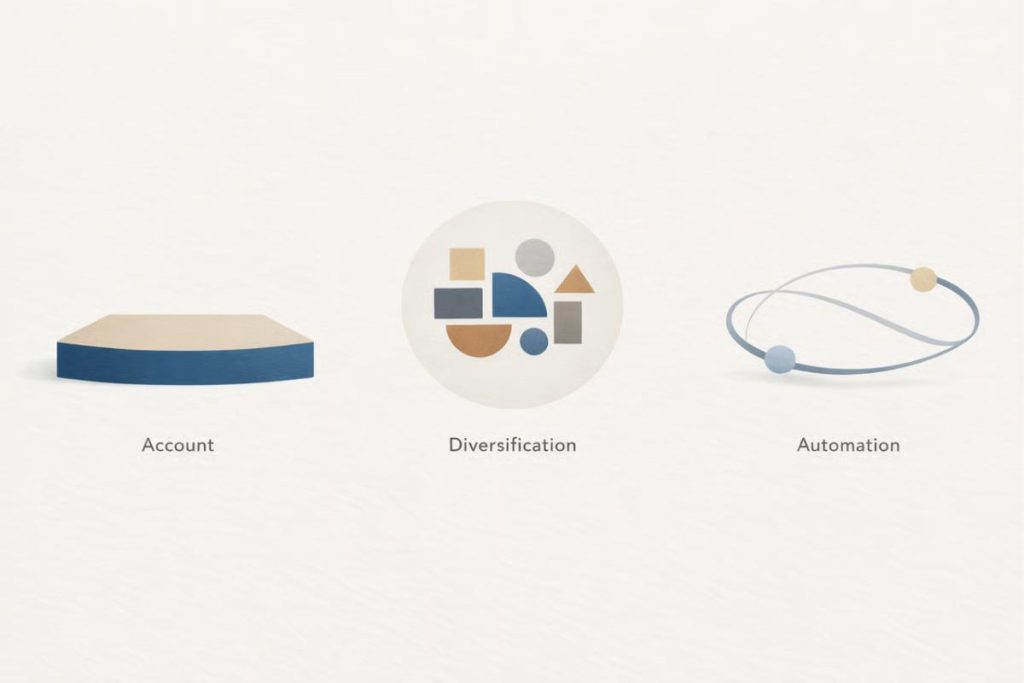
How to Start in 3 Simple Decisions
You don’t need a perfect strategy to begin — just a few clear decisions that remove friction and confusion.
1. Choose the type of account, not the “best” investment
Decide where this money lives: a long-term investing account meant for future growth, not short-term spending. The goal is separation — money you won’t touch for years.
2. Choose broad diversification over clever ideas
Start with simple, diversified investments that represent many companies or markets at once. This removes pressure to pick winners and lets long-term market growth do the work.
3. Automate contributions so decisions disappear
Set a small, repeatable contribution that happens automatically. When investing becomes routine instead of reactive, consistency replaces guesswork.
Once these three decisions are made, the rest of investing becomes maintenance — not constant decision-making.
Automating Contributions (The Beginner’s Lifeline)
Automation is one of the most powerful emotional tools in personal finance.
It:
- Removes hesitation
- Prevents panic
- Forces consistency
- Turns investing into a habit
When markets fall, your automated contributions buy more shares at lower prices — quietly helping you build long-term wealth.
A simple example:
Imagine you invest the same amount every month. When markets are high, your money buys fewer shares. When markets dip, that same contribution buys more shares — automatically. You don’t need courage, predictions, or perfect timing. The system keeps working even when emotions would normally interfere.
Avoiding Common Beginner Traps
A few patterns to watch out for:
- Checking your portfolio every day
- Jumping between “strategies” every month
- Following influencers who speak in extremes
- Investing based on fear or excitement
- Trying to time tops and bottoms
Beginners don’t fail because they lack knowledge.
They fail because they’re pulled in too many directions.
A 10-Minute Monthly Check-In
Instead of micromanaging, set a simple monthly rhythm. It’s small on purpose — and it works because you’ll actually do it.
Look at your contribution plan.
Make sure automation is running.
Revisit your time horizon.
Avoid reacting to short-term noise.
How to Stay Grounded When Markets Move
Even calm investors feel uneasy when the market swings.
You’re human — and volatility is uncomfortable.
But understanding what’s normal and what actually matters can keep you steady when others panic.
Understanding Normal Market Behavior
Markets don’t rise in a straight line.
They move in cycles — sometimes irrational, often emotional, always unpredictable in the short term.
A few truths that help beginners stay grounded:
- Market drops are common, not catastrophic.
- A “crash” every decade is normal.
- Volatility is the price we pay for long-term growth.
- Historically, markets recover — often faster than the fear suggests.
Once you internalize this, you stop interpreting every dip as danger.
Instead, you see it as part of the rhythm.
Why Predictions Fail (Even for Experts)
It’s tempting to rely on forecasts. They create the illusion of certainty.
But the uncomfortable truth is:
No one can predict markets consistently — not experts, not algorithms, not influencers.
If predictions worked, we’d all know the names of the world’s richest forecasters.
We don’t.
What we do know from research:
- Predictions are right roughly as often as random chance.
- Experts disagree as much as amateurs.
- Most major news events are priced in too quickly to trade on.
Letting go of prediction culture frees you from the mental rollercoaster.
The “Clarity Anchor”: Reconnecting With Your Plan
When things get noisy or emotional, return to your anchor:
- Your time horizon
- Your risk comfort
- Your automated contributions
- Your chosen diversified strategy
Ask:
“Has my situation changed — or just the headlines?”
Most of the time, nothing in your long-term plan actually needs adjusting.
Clarity protects you from panic.
Panic destroys decades of progress.
Investing Platforms: What They’re For (and What They’re Not)
Investing platforms are often marketed as decision engines — places that tell you what to buy, sell, or avoid.
In reality, the best investing platforms don’t replace judgment.
They support it.
Used well, they help you:
- Understand business fundamentals
- Compare investments consistently
- See risks you might otherwise miss
- Stay grounded when headlines and opinions multiply
Used poorly, they can create noise, overconfidence, or analysis paralysis.
The difference isn’t the platform — it’s how you use it.
Three Widely Used Platforms — Each Serving a Different Role
Among long-term investors, three platforms consistently stand out. Not because they do the same thing — but because they don’t.
Morningstar — For fundamentals and portfolio health
Morningstar is built for long-term, fundamentals-driven analysis. It shines when you want to understand business quality, valuation, and how individual holdings fit together at the portfolio level. It’s especially useful for investors who hold funds or want a structured, research-heavy perspective.
Simply Wall St — For clarity and first-pass understanding
Simply Wall St focuses on visualizing fundamentals. It’s designed to help you quickly grasp a company’s financial health, valuation, and growth profile without digging through reports. For beginners or visual thinkers, it’s often the fastest way to understand what’s going on beneath the surface.
Seeking Alpha — For depth, debate, and ongoing insight
Seeking Alpha is less a single viewpoint and more a research ecosystem. It combines quantitative ratings with thousands of independent analyses and community discussion. Used thoughtfully, it’s valuable for exploring multiple perspectives — especially when you’re willing to read critically rather than follow consensus.
Each platform has strengths. None should be treated as an oracle.
A calm, durable investing process usually looks like this:
- Your strategy comes first
- Your tools support that strategy
- Your emotions stay out of the decision loop
Platforms are most useful when they help you ask better questions — not when they push you toward quick answers.
Want a Deeper, Side-by-Side Comparison?
We’ve published a comprehensive comparison of Morningstar, Simply Wall St, and Seeking Alpha — focused on what each platform is actually useful for, who it’s best suited to, and how to use them without drifting into prediction culture or overanalysis.
If you’re deciding whether — and how — any of these tools belong in a long-term investing process, this guide walks through the tradeoffs clearly and calmly.
No scores to chase — just context to help you choose deliberately.
Conclusion: A Calmer Way to Build Wealth Over Time
Long-term investing isn’t about beating the market or timing it perfectly.
It’s about creating a simple, grounded structure you can stick with — through the noise, through volatility, through uncertainty.
By understanding your time horizon, automating your contributions, and ignoring prediction culture, you create a sustainable path toward financial growth. It’s not glamorous. It’s not fast. It’s not designed for TikTok virality.
But it works. Quietly. Consistently. Patiently.
If this guide helped clarify things, your next step is to explore deeper, structured learning — especially around risk, asset allocation, and avoiding emotional traps. Mind Treks’ Investing With Clarity trek builds on everything here, helping you turn these ideas into a calm, durable investing practice.
You don’t need perfect timing.
Just a clear path and enough time to walk it.
Continue Your Investing Journey
If this guide helped you see long-term investing more clearly, your next step is to build a calm, durable strategy you can follow for years. The free Investing for Beginners Trek walks you through risk, asset mix, emotional traps, automation, and the deeper mindset behind steady investing — all in a clear, non-hyped, step-by-step series.
Start the Free Trek
Why you can trust this guide
Mind Treks turns complex topics into calm, honest learning — without funnels, hype, or guru theatrics. Every guide is built to help you think clearly, not buy something.
This investing article is based on long-term market research, personal experience navigating volatility, and the principles we teach inside our Investing for Beginners Trek. Our goal isn’t to predict markets — it’s to help you understand them well enough to make grounded, confident choices.
- No stock tips, prediction-chasing, or “millionaire blueprints.”
- Simple, diversified investing concepts grounded in evidence, not hype.
- A focus on emotional clarity — because staying calm matters more than timing the market.
Frequently Asked Questions
A few more common questions people ask when they’re just starting with long-term investing and want a calmer, clearer path.
-
Long-term investing means putting money into assets you expect to grow over years or decades, not days or weeks. Instead of trying to time every high and low, you build a simple plan, invest consistently, and let time and compounding do most of the work.
-
You don’t need a large lump sum to begin. Many platforms let you start with small amounts or even fractional shares. What matters most is choosing an amount you can invest regularly without stress and sticking with that habit over time.
-
Trying to find the perfect moment is a trap. Markets move unpredictably in the short term, and most people who wait for the ideal entry never feel certain enough to act. A calmer approach is to invest on a regular schedule, so you buy during both highs and lows and avoid relying on guesses.
-
For many beginners, broad index funds are a simple way to invest long-term. They spread your money across many companies, keep fees low, and remove the need to pick individual winners. They don’t eliminate risk, but they reduce the pressure to outsmart the market with constant stock picking.
-
Constant monitoring usually increases anxiety without improving results. Many long-term investors review their accounts monthly or quarterly to confirm contributions, check alignment with their plan, and make small adjustments — then step away from the day-to-day noise.