
Introduction
Artificial intelligence touches almost everything now — search engines, chat assistants, writing tools, editing apps, even how we discover information.
But ironically, the more AI shows up in daily life, the harder it feels to understand.
Most explanations swing between extremes:
Either too technical (“transformer-based neural networks using billions of parameters…”)
or too dramatic (“AI will take over everything — prepare yourself!”).
If you’re here, you probably want something else:
A grounded, human explanation of how AI actually works — without jargon, hype, or sci-fi storytelling.
This guide is written exactly for that.
By the end, you’ll have a clear mental model of modern AI, what it can and cannot do, and how to think about it in a calm, practical way.
How AI Actually Works — In One Screen
Short on time? Here’s the calm, plain-English version of what this guide is saying about how modern AI really works.
- Modern AI isn’t magic or consciousness — it’s pattern recognition at scale that predicts what should come next based on examples it has seen.
- Large language models (like GPT) don’t “know” facts; they generate likely text, which is why they can sound confident and still get details wrong.
- These models are trained mostly on large amounts of public text (books, articles, websites), not on your private emails, files, or personal data.
- AI has real limits: it can forget earlier context, reflect biases from its training data, and should never replace human judgment or basic fact-checking.
- The healthiest mindset is to treat AI as a helpful tool or collaborator — the clearer your questions and prompts, the more useful and reliable it becomes.
Why AI Feels Confusing — And What This Guide Will Clarify
AI feels mysterious for two simple reasons:
- The language is unnecessarily complicated.
Most explanations are built for engineers, not normal people who just want clarity. - Media loves drama.
Headlines push extremes — miracle breakthroughs or existential danger.
This article takes the opposite approach:
- Plain English
- No predictions
- No fear-based framing
- No “secret sauce” narratives
- Just practical clarity
Before we dig into the mechanics, here’s the cleanest possible description of modern AI:
AI doesn’t think. It detects patterns and makes predictions based on examples it has seen.
Everything else — text generation, images, coding, reasoning — builds on that single idea.
The Core Idea Behind Modern AI — Learning Patterns, Not Secrets
AI isn’t magic.
It’s pattern recognition at a massive scale.
If you’ve ever read thousands of books, you start recognizing how stories tend to flow — the rhythms, themes, turns of phrase, and endings.
Large AI models work the same way, just on a far larger dataset.
A simple analogy
Imagine you read:
- 500 cookbooks
- 2000 recipes
- 400 food blogs
- Thousands of comments and reviews
Eventually, someone could ask:
“How do I make a good pasta sauce?”
And even without memorizing a specific recipe word-for-word, you could predict a solid answer because you’ve absorbed so many patterns.
That’s all modern AI is doing:
- It takes in huge amounts of examples.
- It notices patterns.
- When you prompt it, it predicts what should come next based on those patterns.
No consciousness.
No hidden intentions.
No private access to your files, emails, or personal life.
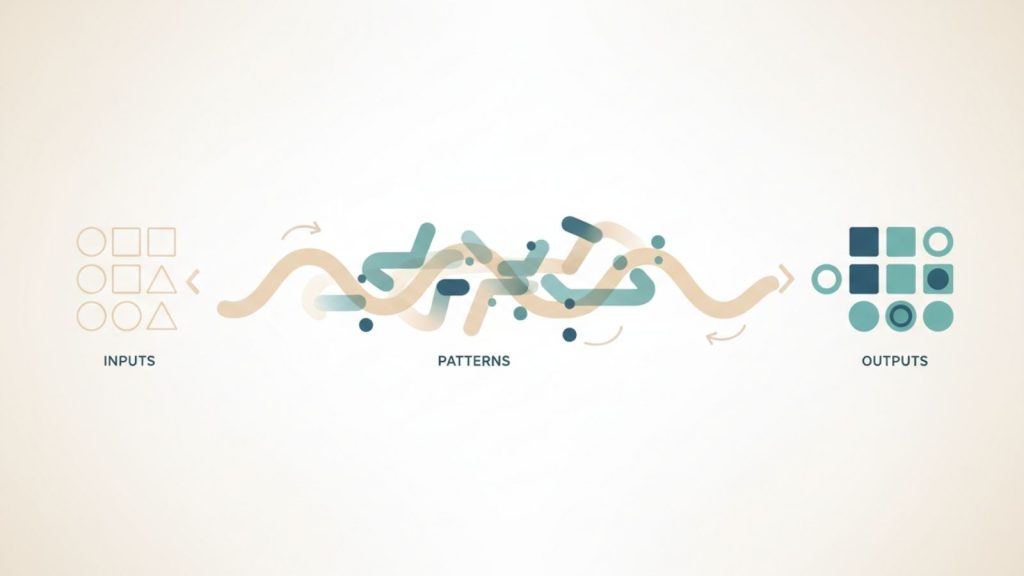
Just pattern → prediction → response.
What Large Language Models Actually Do (GPTs, LLaMs, Claude, etc.)
Large Language Models (LLMs) — like GPT — are trained to take in text and predict the next most likely piece of text.
That’s the entire “intelligence.”
Here’s the basic loop:
- You give a prompt.
(“Explain gravity like I’m 12.”) - The model breaks it into tokens (small chunks of text).
- It searches its internal pattern map — built during training — for similar structures.
- It predicts the next token, then the next one, then the next one, until it forms a coherent answer.
This is why AI responses feel fluent and conversational.
The model isn’t “knowing” the answer; it’s predicting what answer fits.
Why the word “prediction” matters
Because predictions can be:
- remarkably accurate
- slightly wrong
- or confidently incorrect
This is why AI sometimes invents things — not because it’s trying to mislead you, but because it’s completing a pattern that looks right even if it isn’t factual.
This is called a “hallucination,” and it’s not a glitch.
It’s a natural limitation of predictive systems.
What Data These Models Learn From (Without the Conspiracy Spin)
Modern AI is trained on broad, publicly available text such as:
- Books
- Educational sites
- News articles
- Wikipedia
- Public forums
- Open datasets curated by researchers
What AI is not trained on:
- Your private files
- Your personal emails
- Your saved images or messages
- Passwords, bank accounts, chats, etc.
(Companies would face immediate legal ruin if they tried.)
The key idea:
AI learns from what’s publicly available — not from your personal life.
And while “more data” helps models become more general, it doesn’t give them a deeper kind of intelligence.
It simply increases the number of patterns they can draw from.
The Limits of AI Most People Don’t Talk About
AI can feel impressive, but it has very real boundaries.
Here are the big ones:
- AI doesn’t understand context the way humans do.
It fakes coherence through pattern prediction. - AI forgets things mid-conversation because it can only hold a limited amount of text at a time (“context window”).
- AI can reflect biases if those biases are present in the training data.
- AI is not a source of truth.
It’s a source of statistically likely language. - AI struggles with ambiguity unless you guide it clearly.
Context windows: why AI “forgets”
Models don’t have memory.
Each answer is generated using only the text visible in the current conversation window.
Once that scrolls past a certain limit, the model can’t “see” it anymore.
This is why prompts matter.
Clear instructions = fewer mistakes.
Want to Explore More Mind Treks?
We’ve built a growing collection of free, structured learning journeys across psychology, decision-making, career growth, money clarity, and more. No funnels. No upsells. Just deep, honest learning.
Browse All TreksThe Practical Way to Think About AI — A Tool That Amplifies You
AI isn’t a brain.
It’s not a replacement for judgment.
And it’s not going to magically take over all your tasks.
The most realistic way to think about AI is this:
AI is a tool that expands your ability to work, think, and create — but only if you learn to use it clearly.
Treat AI as a collaborator:
- You provide direction.
- It provides drafts, ideas, summaries, and structure.
- You evaluate, refine, correct, and apply judgment.
This mindset removes pressure and unrealistic expectations.
Where AI shines in everyday life
- Summarizing complex text
- Generating clean outlines
- Brainstorming ideas
- Explaining difficult concepts
- Cleaning up writing
- Helping with coding
- Organizing thoughts clearly
- Mocking up examples or templates
And this leads naturally to one of the most valuable beginner skills:
Knowing how to ask AI better questions.
Prompting isn’t magic — it’s just clear communication.
Knowing how to ask AI better questions is a practical form of digital literacy
Good prompts aren’t about tricks or secret formulas.
They’re about clarity:
- What do you want?
- Why do you want it?
- What should the AI consider?
- What should it ignore?
- What does “good” look like to you?
The clearer you are, the better the model performs.
It’s the same dynamic you’d have when working with a human colleague.
This is why learning basic prompting principles is becoming just as fundamental as learning to type or use email.
Not because AI replaces humans — but because humans who know how to direct AI get more out of it with less effort.
This whole idea gently leads into the next layer of modern digital literacy: treating AI as a tool you guide, not a tool that guides you.
Conclusion: Bringing AI Back Down to Earth
AI becomes far less intimidating when you see it for what it really is:
- A pattern-recognition system
- A prediction machine
- Not a thinker
- Not conscious
- Not a mysterious force with hidden intentions
It’s powerful, yes — but also limited, mechanical, and dependent on how clearly we use it.
If there’s one takeaway from this guide, it’s this:
You don’t need to become an expert to understand AI. You just need a clear mental model for how it works, what it’s good at, and where its limits are.
From here, a natural next step is learning how to communicate with AI more effectively — a kind of modern “digital literacy” that helps you use it confidently at work, at home, and in learning.
If you want to go deeper, the Prompt Engineering Foundations Trek builds on everything in this post.
It teaches the simple techniques anyone can use to get higher-quality results without needing to be technical.
For now, you have the essentials.
The mystery is gone.
AI is no longer a black box — just a tool, like any other, that becomes more useful the more clearly you work with it.
Ready to Use AI More Effectively?
Now that you understand how AI actually works beneath the surface — prediction, patterns, and limits — the next step is learning how to communicate with it clearly. Our free Prompt Engineering for Beginners Trek teaches you the practical skills for getting reliable, high-quality results from modern AI models without needing any technical background. If you want AI to become a helpful tool rather than a confusing black box, this Trek is the natural next move.
Start the Free Trek
Why you can trust this guide
Mind Treks creates clear, jargon-free explainers on complex topics — from AI to psychology — built for thoughtful readers who want real clarity without hype.
This guide to how AI actually works is grounded in years of hands-on experimentation with modern AI tools, research into how large language models function, and a commitment to explaining technology in plain, honest language.
- No futurist predictions, fear-based narratives, or “AI secret hacks.”
- Simple explanations of how pattern-based models work — and where their limits truly are.
- A focus on human judgment, critical thinking, and practical digital literacy.
Frequently Asked Questions
A few common questions people ask when they’re trying to understand how AI actually works — without jargon, hype, or sci-fi drama.
-
Modern AI doesn’t understand in the human sense. Large language models look at your words, compare them to patterns they’ve seen during training, and then predict the next most likely word or phrase. The result often feels like understanding, but under the hood it’s pattern-based prediction, not awareness or comprehension.
-
Foundation models are trained mainly on large collections of public text, such as books, articles, and websites. They don’t secretly read your emails or personal files. Some apps may use your data to improve their specific product if you opt in, but that’s different from the core model training on public datasets. Always check the privacy settings of the tools you use, but the default is: public data in, not your private life.
-
Because the model is optimizing for fluent, likely-sounding text — not guaranteed truth. If the patterns it has seen suggest a particular phrase or “fact,” it will generate it even if it’s incorrect. This is why experts talk about “hallucinations”: the model fills in gaps with plausible but made-up details. It’s a powerful assistant, but it still needs your judgment and spot-checking, especially for important decisions.
-
AI is already changing how many jobs are done, but in most fields it behaves more like a powerful assistant than a full replacement. People who understand how AI works — and how to give it clear, structured instructions — are better positioned to do higher-quality work in less time. Learning to treat AI as a tool that amplifies your skills is usually more realistic (and less stressful) than assuming total replacement.
-
Start by being specific about what you want: the context, the goal, the format, and any constraints that matter. Ask AI to show its steps, not just its final answer. Use it to draft, summarize, compare options, or clarify your thinking — then apply your own judgment. In practice, better prompts and a clear mental model of how AI works matter far more than “secret hacks” or complex settings.