
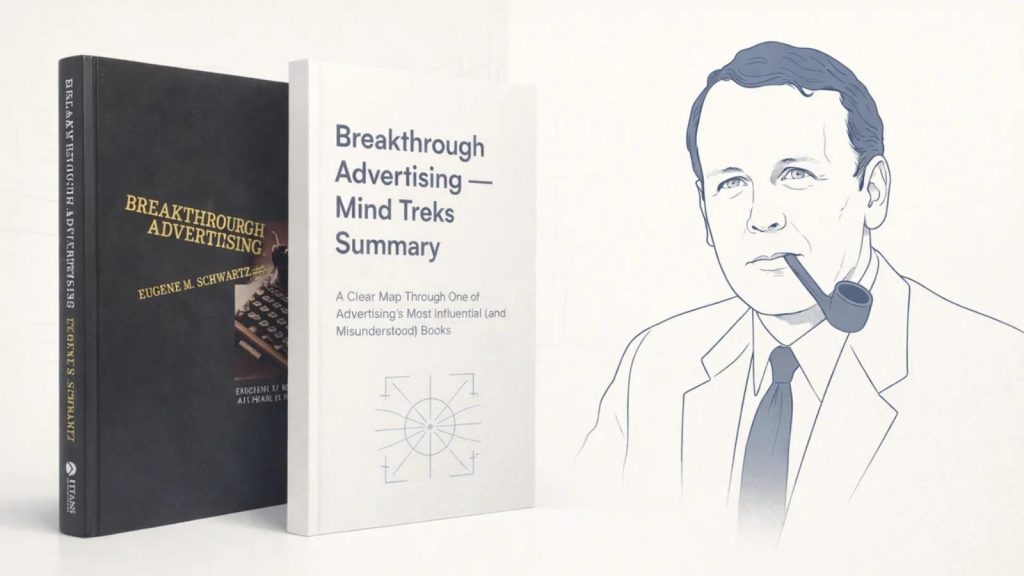
Introduction
If you’ve searched for a Breakthrough Advertising summary, you’ve probably heard the same things: it’s legendary, it’s rare, and it’s “the copywriting bible.”
All of that is partly true. But it’s also incomplete.
Breakthrough Advertising by Eugene Schwartz is not a light read. It’s dense. Technical. At times intense. And often interpreted through a purely sales-driven lens. Yet beneath the old-school direct response language lies something far more interesting: a serious framework for understanding markets, human desire, and how persuasion actually works.
In this article, we’ll walk through what the book is really about, how it’s structured, and why it still matters — especially in an AI-saturated world. If you want a companion resource while reading, we’ve created a structured, calm PDF summary guidebook that distills the key ideas clearly and ethically. You can download it freely as you go (scroll to the bottom of this post, near the conclusion).
Let’s start with the foundation.
Key Takeaways at a Glance
Short on time? Here’s what this guide on Breakthrough Advertising is really about.
- Breakthrough Advertising is not a book of copywriting tricks — it’s a framework for understanding markets, mass desire, and how belief is built.
- The five stages of awareness and market sophistication explain why certain messages work at specific moments — and fail at others.
- Schwartz argues that advertising does not create desire; it channels what already exists in the market.
- The book’s two-part structure moves from diagnosis (strategy) to execution (seven persuasion techniques).
- When applied ethically, these ideas improve clarity and alignment — not manipulation.
What Is Breakthrough Advertising and Why Has It Remained Influential Since 1966?
Breakthrough Advertising is a book about markets and desire — not about clever copy tricks — and that’s why it still matters.
Published in 1966, Breakthrough Advertising was written during the golden era of direct response marketing. It didn’t become a mainstream bestseller. Instead, it quietly shaped generations of serious marketers and business builders.
Over time, it earned a reputation as a “classic” because it tackled something deeper than tactics:
- Why certain messages work at specific moments in a market’s evolution
- Why others fail — even if they sound persuasive
- How human desire precedes advertising, rather than being created by it
Why It Became a Classic in Direct Response
Most marketing books offer tactics:
- How to write headlines
- How to structure sales pages
- How to increase conversions
Schwartz did something different. He focused on:
- Mass desire
- Market awareness stages
- Market sophistication levels
- The relationship between desire, identity, and belief
Instead of teaching “what to say,” he taught how to think about markets.
That shift — from surface-level copy to underlying psychology — is why the book still gets referenced decades later.
How It Differs from Modern Marketing Books
Modern marketing books often emphasize:
- Growth hacks
- Funnels
- Automation systems
- Platform-specific tactics
Breakthrough Advertising barely touches any of that.
It’s about:
- The structure of persuasion
- The evolution of markets over time
- The internal state of the prospect
In other words, it’s strategic rather than tactical.
Why It’s Often Misunderstood
Because it’s associated with direct response marketing, the book is sometimes framed as a “copywriting trick manual.”
It’s not.
Yes, it contains headline frameworks and persuasion techniques. But its core thesis is simple:
Advertising cannot create desire. It can only channel what already exists.
That’s a very different posture than manipulation.
At its heart, the book is about understanding:
- What people already want
- How aware they are of solutions
- How crowded the market is
- And how belief is formed
That’s also precisely why we created a structured summary guide. The original book is powerful — but dense. Our goal was not to dilute it, but to clarify it. To separate the enduring principles from the dated tone. To make the architecture visible.
Who Was Eugene Schwartz and Why His Work Still Matters Today?
Eugene Schwartz was a serious student of markets and human behavior, not a guru — and that’s why his work still feels relevant.
Eugene M. Schwartz was a copywriter, author, and market thinker active in the mid-20th century. He wrote for major direct mail companies and built a reputation for producing campaigns that generated extraordinary returns.
But reducing him to “a successful copywriter” misses the point.
He was:
- A market analyst
- A psychological observer
- A strategist obsessed with demand dynamics
A Brief Biographical Snapshot
Schwartz authored several books, including:
- How to Double Your Child’s Grades in School
- How to Double Your Power to Learn
- Breakthrough Advertising (1966)
In later reflections, he admitted something important: when he first wrote Breakthrough Advertising, he thought it was a book about advertising.
Years later, he realized it was actually a book about creating markets.
That distinction matters.
His Influence on Later Marketers
Many well-known direct response marketers cite Schwartz as foundational. His ideas shaped:
- Headline writing philosophy
- Awareness-based messaging
- Mechanism-driven positioning
Even marketers who’ve never read him often use his frameworks indirectly.
But influence alone isn’t what makes his work valuable today.
Why His Thinking Feels Modern in the AI Era
In a world where AI can generate copy instantly, what becomes scarce?
- Deep market understanding
- Context awareness
- Sophistication sensitivity
- Psychological nuance
AI can remix patterns. It cannot diagnose a market stage without human framing.
Schwartz’s emphasis on:
- Awareness levels
- Market maturity
- Belief architecture
feels surprisingly aligned with modern strategic thinking.
He wasn’t chasing hacks. He was studying structure.
And that makes him relevant now.
How Is Breakthrough Advertising Structured? A Clear Breakdown of Its Two Main Parts
The book is divided into two parts — diagnosis (strategy) and execution (technique).
Understanding the structure helps demystify the book immediately. It’s not a random collection of tactics. It’s a layered system.
Part 1 – The Basic Strategy of Persuasion
Part 1 is about diagnosis. It teaches you how to understand the market before writing a single word.
This section covers:
- Mass Desire
Advertising does not invent desire. It focuses existing desire onto a product. - State of Awareness
Prospects move through stages:- Unaware
- Problem-aware
- Solution-aware
- Product-aware
- Most aware
- Market Sophistication
As markets mature:- Simple claims stop working
- Bigger claims lose credibility
- Mechanisms and differentiation become essential
- Headline Construction and Verbalization
Schwartz lists dozens of ways to express a claim more vividly:- Specificity
- Measurement
- Speed
- Comparison
- Sensory language
- Creative Planning
He emphasizes that every market-product combination is unique. Templates don’t replace thinking.
Key insight:
Part 1 is about asking the right questions. It’s strategic diagnosis, not wordsmithing.
Part 2 – The Seven Techniques of Breakthrough Advertising
Part 2 moves into execution. Once you understand the market, how do you structure persuasion?
Schwartz outlines seven core techniques:
- Intensification
Expand and sharpen existing desire. Make it vivid and concrete. - Identification
Connect the product to the buyer’s self-image and aspirations. - Gradualization
Build belief step by step. Don’t confront skepticism abruptly. - Redefinition
Reframe the product to remove objections or avoid direct competition. - Mechanization
Explain the “how.” Provide a mechanism to support claims. - Concentration
Narrow attention onto your product as the best path to fulfillment. - Camouflage
Borrow credibility through structure, storytelling, or authority.
These techniques are not scripts. They’re persuasion architecture.
They correspond to three core psychological dimensions:
- Desire
- Identity
- Belief
Key insight:
Part 2 is about structured persuasion — not manipulation, but ordered presentation.
Together, Part 1 and Part 2 form a complete system:
- Diagnose the market
- Understand the prospect
- Structure the message
- Build belief logically
When read carefully, the book becomes less about hype — and more about clarity.
Want to Explore More Mind Treks?
We’ve built a growing collection of free, structured learning journeys across psychology, decision-making, career growth, money clarity, and more. No funnels. No upsells. Just deep, honest learning.
Browse All TreksWhat Are the Core Ideas Behind Breakthrough Advertising (Explained Simply)
Short answer: The core ideas of Breakthrough Advertising revolve around desire, awareness, market evolution, and belief formation — not tricks.
At its heart, the book is trying to answer one question:
Why do certain messages work — and others fail — even when both seem persuasive?
Schwartz’s answer is structured. And once you see it, it’s difficult to unsee.
Let’s break down the key principles clearly.
1. Advertising Does Not Create Desire — It Channels It
This is the foundation.
Schwartz argues that desire already exists in the market. People already want:
- Security
- Status
- Health
- Freedom
- Recognition
- Relief
Your job is not to invent those desires. It’s to direct them toward your product.
That single idea changes everything.
Instead of asking, “How do I make people want this?”
You ask, “What do they already want — and how does this genuinely help?”
That shift alone makes marketing more honest.
2. The Five Stages of Awareness
One of the most widely cited ideas from the book is the five stages of awareness.
Prospects move through these stages:
- Completely Unaware – They don’t know they have a problem.
- Problem Aware – They feel pain but don’t know solutions.
- Solution Aware – They know solutions exist.
- Product Aware – They know your type of product.
- Most Aware – They know your product and just need reassurance.
The mistake most marketers make?
They write as if everyone is “most aware.”
But if someone is problem-aware, a direct product pitch feels premature.
If someone is product-aware, re-explaining the problem feels repetitive.
Matching awareness to message is not manipulation.
It’s alignment.
BONUS: you can read and get a picture of how Gene wrote ad copy masterfully and aligned awareness to message on this swiped page.
3. Market Sophistication Changes What Works
Markets evolve.
In early stages, simple claims work:
- “Lose weight fast.”
- “Earn money online.”
As competitors pile in, claims escalate:
- “Lose 30 pounds in 30 days.”
- “Make $10,000 in your first month.”
Eventually, the market becomes skeptical.
At that point:
- Mechanisms matter more than claims.
- Specific differentiation becomes essential.
- Identity positioning replaces bold promises.
Understanding market sophistication helps you avoid shouting louder when you should be clarifying deeper.
4. Desire, Identity, and Belief Interact
Schwartz divides persuasion into three psychological dimensions:
- Desire – What the prospect wants.
- Identification – Who they want to be.
- Belief – What they accept as true.
Effective marketing touches all three.
For example:
- Desire: “I want financial freedom.”
- Identity: “I see myself as independent.”
- Belief: “This method feels realistic.”
If belief collapses, the sale collapses.
That’s why the book devotes so much attention to building conviction step by step.
5. Mechanisms Matter in Mature Markets
In saturated markets, bold claims lose credibility.
People want to know:
- How does this work?
- Why is it different?
- Why should I trust this one?
Schwartz calls this “mechanization” — explaining the underlying mechanism.
Today, we might call it transparency.
In modern ethical marketing, this looks like:
- Explaining your process
- Showing your reasoning
- Sharing case context
- Providing logic, not just outcomes
That’s not hype. That’s clarity.
How to Apply Breakthrough Advertising Ethically in Modern Marketing
Short answer: The book’s principles can be used manipulatively — or responsibly. The difference is intent and transparency.
This is where thoughtful readers often hesitate.
Isn’t this just persuasion psychology?
It can be. But it doesn’t have to be.
Let’s translate the ideas into ethical practice.
Channel Desire — Don’t Manufacture Insecurity
There’s a difference between:
- Identifying an existing desire
- Creating a new insecurity to exploit
Ethical application asks:
- Is this desire already present?
- Does my product genuinely help fulfill it?
If not, no amount of copy will make it sustainable.
Use Awareness Levels to Clarify, Not Pressure
Awareness stages can help you:
- Avoid overwhelming beginners
- Avoid under-explaining for skeptics
- Provide context before asking for action
They should not be used to manipulate someone from unaware to anxious.
When done well, awareness-based messaging feels educational.
Respect Market Sophistication
When a market is mature:
- Exaggerated claims erode trust.
- Transparency builds differentiation.
Instead of escalating promises, you can:
- Narrow focus
- Define your niche
- Clarify your mechanism
- Be specific about limitations
Clarity outperforms noise in the long run.
Build Belief Slowly
Gradualization — building belief step by step — can feel manipulative if rushed.
But done ethically, it means:
- Showing your reasoning
- Anticipating objections honestly
- Admitting trade-offs
- Letting the reader conclude
That builds durable trust.
Reframe Mechanism as Transparency
The “mechanism” in modern ethical marketing becomes:
- Process explanation
- Educational breakdown
- Open methodology
Not a mysterious “secret formula.”
The difference is tone.
One hides.
One clarifies.
Why Breakthrough Advertising Is Especially Relevant in the Age of AI-Generated Content
As AI increases content volume, structural thinking becomes more valuable.
AI can generate:
- Headlines
- Hooks
- Sales pages
- Scripts
What it cannot do on its own:
- Diagnose market sophistication
- Interpret awareness levels accurately
- Understand evolving desire patterns
- Build belief architecture from lived experience
As content volume explodes, two things happen:
- Surface-level persuasion becomes commoditized.
- Deep psychological clarity becomes scarce.
Schwartz focused on the second.
That’s why his work feels increasingly relevant.
In an AI era, those who understand:
- Market evolution
- Identity-based positioning
- Belief formation
will outperform those relying purely on output speed.
Frameworks outlast tools.
Download the Structured Summary Guidebook (Free Companion Resource)
If you’ve made it this far, you can probably sense it:
Breakthrough Advertising is not casual reading.
It’s valuable — but dense.
That’s exactly why we created a structured summary guidebook.
The guide:
- Breaks down both parts clearly
- Explains each major concept in plain language
- Reframes persuasion through an ethical lens
- Separates timeless principles from outdated tone
It’s designed to sit beside the original — not replace it.
You can download the full PDF freely here, no sign-up required.
If the book feels like a mountain, this is the trail guide.
Conclusion: Why Breakthrough Advertising Is Still Worth Studying — Carefully
Breakthrough Advertising is not a book of tricks.
It’s a book about:
- Markets
- Desire
- Identity
- Belief
- Evolution
It can absolutely be misused.
But when read carefully, it becomes something else entirely — a framework for understanding how humans make decisions in context.
In a noisy world, cleverness is common.
Clarity is rare.
If you study this book with integrity, you don’t become more manipulative.
You become more aware.
And awareness, used responsibly, is powerful.
If you want a structured way to explore it further, download the companion summary guide and work through it slowly.
What’s one idea from this framework that changes how you see marketing?
Frequently Asked Questions
A few more questions people often ask after learning what Breakthrough Advertising is really teaching — and how to use it without turning into a hype machine.
-
Yes — because it’s less about writing and more about how markets work. If you build products, write content, run a newsletter, or make offers of any kind, the awareness and market sophistication ideas can help you communicate more clearly.
-
Start by matching your message to the reader’s awareness level instead of pushing a pitch too early. When people feel understood — and you explain the mechanism calmly — persuasion tends to feel like clarity, not pressure.
-
Look at the promises your competitors make and how often they repeat them. If the market is full of big claims, skepticism is usually high — which means you’ll need specificity, proof, and a clear mechanism instead of louder promises.
-
Not automatically. The same tools can be used to clarify a real solution or to pressure someone into a bad decision. A simple ethical test is: would you still feel good if the reader used this information to make a slower, more informed choice?
-
If you’re serious about learning it deeply, yes. The summary helps you grasp the structure quickly, but the original book contains examples and nuance that sharpen your judgment — especially around belief-building and market evolution.

Why you can trust this guide
We build calm, structured learning resources for thoughtful people — without funnels, manufactured urgency, or “guru” theatrics.
This article is based on a full, careful read of Eugene Schwartz’s Breakthrough Advertising and the real work of translating dense ideas into usable frameworks. We’ve seen the same pattern repeatedly: people copy surface-level tactics, then wonder why their message feels pushy (or why it stops working). Schwartz’s best contribution isn’t a trick — it’s a way to diagnose where a market actually is, what people already want, and what kind of proof they truly need.
- We summarize the book’s structure and concepts in plain language, without watering them down.
- We focus on ethical application: clarity, consent, and honest mechanisms over pressure and theatrics.
- We treat persuasion as communication — helping the right people understand the right offer at the right time.
Build Without Becoming a Shovel Seller
If studying Breakthrough Advertising sparked a deeper question — “How do I use persuasion responsibly?” — the next step isn’t another copywriting tactic. It’s a clearer philosophy of business. Our free No Shovel Seller Trek explores how to build, market, and grow without exploiting fear, urgency, or manufactured desire — while still being strategic and effective.
Start the Free Trek